
French industrial expertise · Since 1994
Welding fumes: risks, obligations and capture
Carcinogenic welding fumes, the obligation to capture at source, arm, table or extractor: what employers need to know before equipping their workstations.
01 / Welding fume guide
Fumes classified as carcinogenic
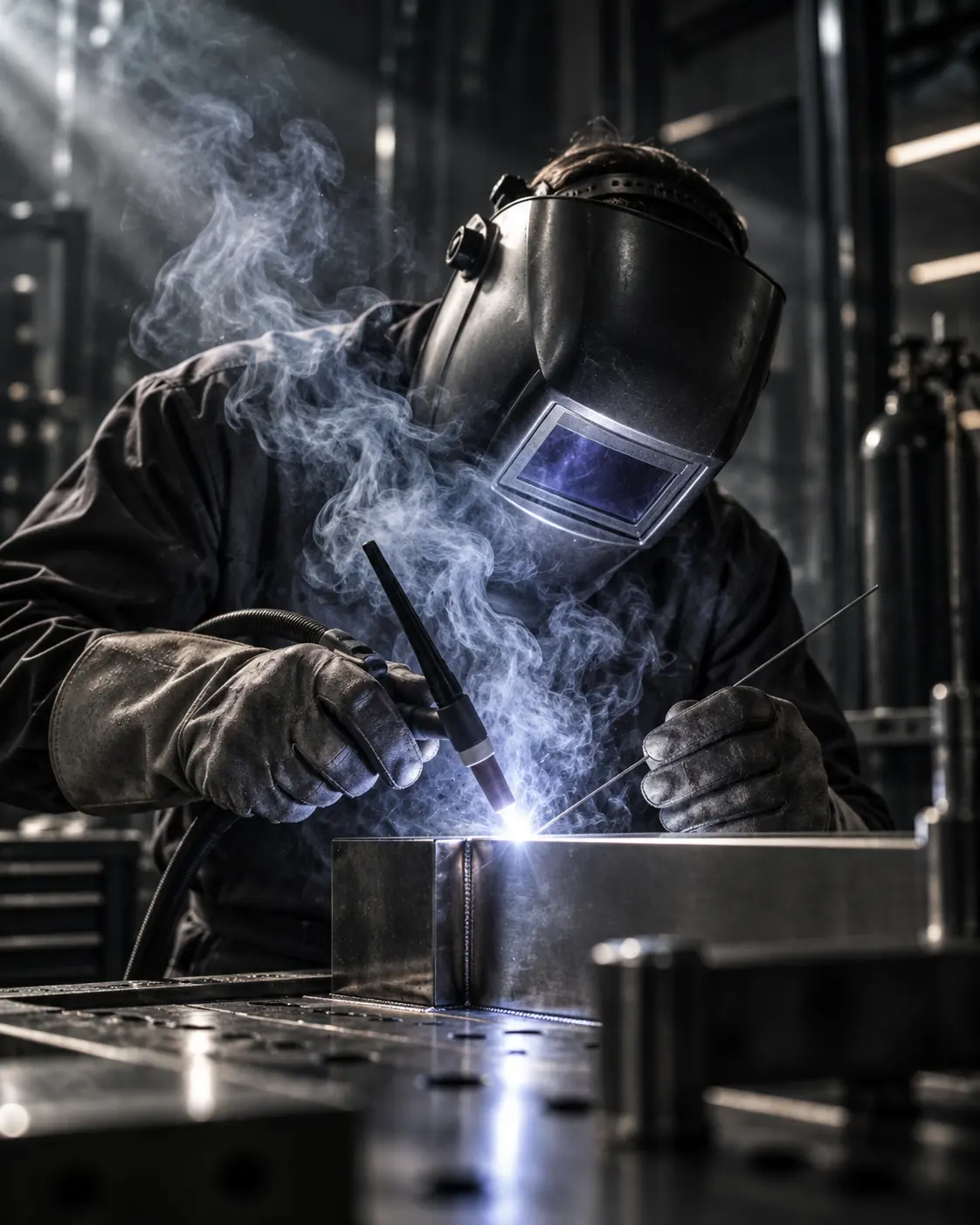
The International Agency for Research on Cancer (IARC) has classified welding fumes as carcinogenic to humans (group 1) since 2017. Welding stainless steel also releases hexavalent chromium and nickel.
The particles are very fine: they stay in suspension for a long time and penetrate deep into the lungs.
02 / Welding fume guide
What the regulations require
The French Labour Code requires pollutants to be captured as close as possible to their emission point and polluted air to be removed from work areas.
The employer assesses the chemical risk, records it in the risk assessment document and puts collective protection in place before personal equipment.
03 / Welding fume guide
Choosing the capture device
An articulated arm for a manual workstation where the part changes position, a downdraft table for medium-sized parts, a hood built into the torch or the cell for robotic welding.
The hood must stay close to the weld: a poorly repositioned arm captures almost nothing.
04 / Welding fume guide
Mobile extractor or central system
For one or two workstations, a mobile filtering extractor from 1,000 to 3,000 m³/h, with a pre-filter and a high-efficiency filter.
For a shop with several workstations, ductwork connects the hoods to centralised filtration and a central fan.
05 / Welding fume guide
Preparing your project
The number of workstations and welders working simultaneously, the processes (MIG, MAG, TIG, stick electrode), the materials welded including stainless steel, the size of the parts and the shop layout.
Useful answers
Frequently asked questions
Are welding fumes carcinogenic?
Yes. The IARC has classified them in group 1, carcinogenic to humans, since 2017.
Is general ventilation enough?
No. Fumes must be captured at source, as close as possible to the weld. General ventilation complements this capture.
Is a mask needed if the workstation has capture?
Collective protection comes first. Personal respiratory protection is added when the risk assessment shows that capture is not enough.
Continue your selection
Related solutions and guides
Your industrial project
Tell us what you need.
Tell us the number of workstations, the processes and the materials welded: we define the capture and filtration and send you a quote.
Contact us
Let’s talk about your installation.
A technician from our engineering office studies your needs and proposes the right solution for your workshop: machine, capture, ductwork and filtration.
Reply within 48 working hours.
Your request, step by step
-
1
You describe your needs
Pollutant, workstations, constraints: a few lines are enough. A photo of the installation helps us a lot.
-
2
Our engineering office studies it
Capture, airflow, ductwork and filtration are sized for your site, together with you if anything needs clarifying.
-
3
You receive a written proposal
Machine, options and price, in detail: you decide with full knowledge of the facts.
- Since 1994in industrial air treatment
- In-house engineering officefrom design to supply
- All brandsfilters and spare parts
- French Fabnetwork member