
French industrial expertise · Since 1994
Enclosures and capture hoods for industrial workstations
Distance, shape and airflow of a capture hood: the INRS rules for capturing a pollutant at source with as little air as possible.
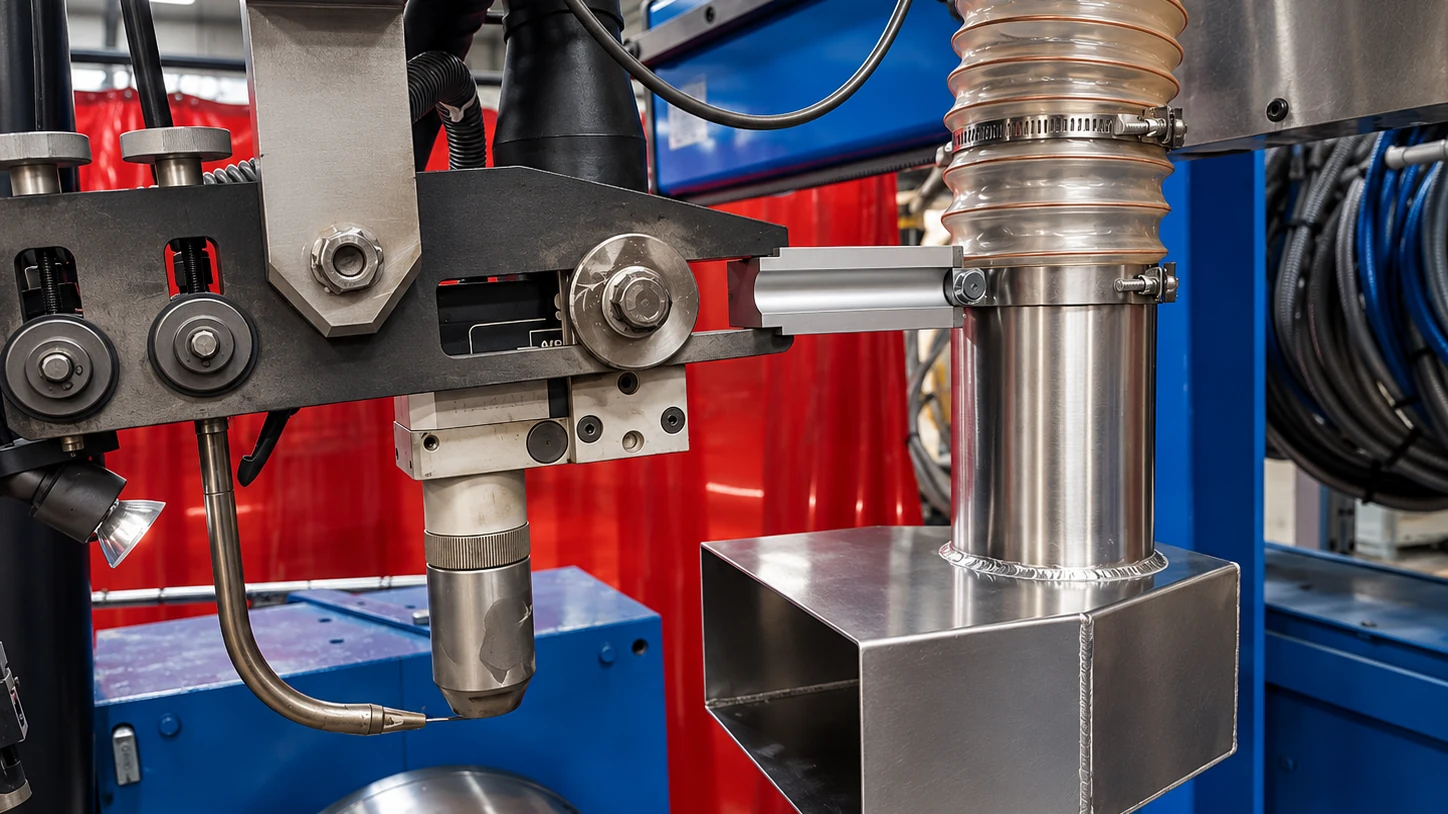
01 / Enclosures and capture
Capture velocity depends on the emission
The INRS sets the air velocity to achieve at the emission point according to how the pollutant is released (ED 695, table III): 0.25 to 0.5 m/s for evaporation in still air (tanks, degreasing), 0.5 to 1 m/s for slow emission (welding, pickling), 1 to 2.5 m/s for active emission (bagging, continuous filling), 2.5 to 10 m/s for high-speed projection (grinding, blasting).
02 / Enclosures and capture
Distance is very expensive
In front of an opening, the velocity falls to a tenth of its value at a distance equal to its diameter. To get the same velocity twice as far away, four times the airflow is needed.
For a plain opening without a flange, the INRS gives Q = V × (10 X² + A), where X is the distance to the emission point and A the area of the opening. A flange reduces the airflow by about 25%; an opening resting on a surface, by half.
03 / Enclosures and capture
Enclose rather than extract hard
The more the hood surrounds the emission, the less air it needs: an enclosure or booth is simply calculated on the area of its openings, at 0.5 to 1 m/s if the pollutant is not projected outwards. A slot hood along a tank, or a Pouyès ring around an opening, captures with a reduced airflow.
The hood must leave room for hands, parts and light, and must never force anyone to remove the machine guards. It is the design of the hood, not the power of the fan, that delivers the result.
04 / Enclosures and capture
What we need to design the hood
Photos of the workstation in operation, a dimensioned drawing of the working area, the pollutant, and the positions of the operator and the parts. Our engineering office draws the hood and calculates its airflow and the pressure drop of the connection.
Useful answers
Frequently asked questions
Can a capture hood be added to an existing machine?
Yes, it is the most common case. The hood is designed around the machine, its guards and the operator’s access, from photos and dimensions.
Should the fan be chosen before the hood?
No, always after. The hood sets the airflow; the hood, ductwork and filter set the pressure. The fan is selected at that operating point.
Your industrial project
Tell us what you need.
Send us photos of the workstations, the materials worked, which workstations run at the same time and your working hours: we size the capture and filtration and send you a costed quote.
Contact us
Let’s talk about your installation.
A technician from our engineering office studies your needs and proposes the right solution for your workshop: machine, capture, ductwork and filtration.
Reply within 48 working hours.
Your request, step by step
-
1
You describe your needs
Pollutant, workstations, constraints: a few lines are enough. A photo of the installation helps us a lot.
-
2
Our engineering office studies it
Capture, airflow, ductwork and filtration are sized for your site, together with you if anything needs clarifying.
-
3
You receive a written proposal
Machine, options and price, in detail: you decide with full knowledge of the facts.
- Since 1994in industrial air treatment
- In-house engineering officefrom design to supply
- All brandsfilters and spare parts
- French Fabnetwork member