
French industrial expertise · Since 1994
Articulated extraction arms for welding fumes and dust
Self-supporting articulated arms to capture welding fumes and point emissions at the workstation: 0.5 m/s at the emission point, connected to a mobile extractor or a ductwork system.
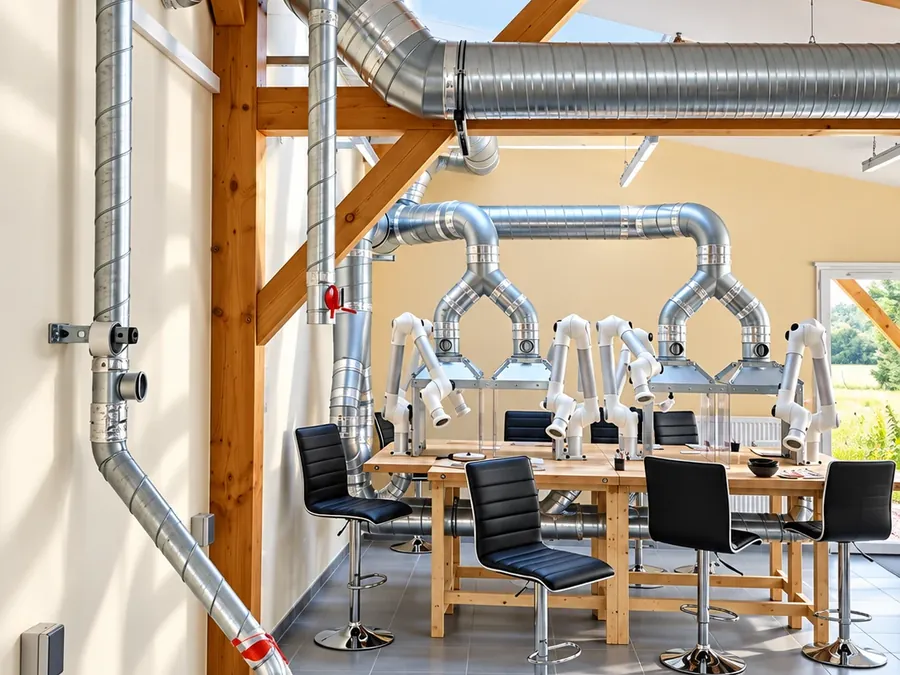
01 / Articulated extraction arms
What an articulated arm is for
The arm brings the capture hood over the workpiece, where the fumes form, and is repositioned at every change of position. It suits manual workstations where the weld or operation moves: MIG, MAG, TIG or stick welding, brazing, small rework operations.
Being self-supporting, it holds its position without constant adjustment: the operator moves it with one hand.
02 / Articulated extraction arms
The values to achieve
For welding fumes, the air velocity must exceed 0.5 m/s at the emission point, with the hood placed behind and above the weld (French Health Insurance specifications for capture subsidies). This requires 1,200 to 1,500 m³/h per arm on a medium-pressure extractor.
Distance is decisive: in front of an opening, velocity falls to a tenth of its value at a distance equal to its diameter (INRS ED 695). An arm left 60 cm from the weld captures almost nothing: it must be brought back for every part.
03 / Articulated extraction arms
Mobile extractor or ductwork
For a single workstation, the arm is mounted on a mobile filtering extractor (EX, FM or CUBIC, from 1,000 to 3,000 m³/h), with a pre-filter and a high-efficiency filter.
For several workstations, each arm is connected to a ductwork system, with a central fan and filter and discharge outside. A damper on each arm closes unused stations and reduces the total airflow.
04 / Articulated extraction arms
Length, diameter and mounting
Arms are available from 1.5 to 11 m long, in 100, 125 or 160 mm diameter. The length sets the working radius around the mounting point: to weld on a 3 m part, choose a 3 to 4 m arm.
The diameter follows the airflow. To keep 12 to 16 m/s in the hose: Ø 100 for 350 to 450 m³/h, Ø 125 for 550 to 700 m³/h, Ø 160 for 870 to 1,150 m³/h, Ø 200 for 1,350 to 1,800 m³/h. For the 1,200 to 1,500 m³/h needed for welding, choose Ø 160 or Ø 200.
The arm is mounted on a wall, on the ceiling, on a jib boom that extends its reach, or directly on a mobile extractor. Its articulated supports sit outside the hose: pressure drop stays low and the arm holds by itself, even fully extended.
05 / Articulated extraction arms
Fumes, vapours or dust: the right arm
Welding fumes and common vapours: standard arm, aluminium with polyurethane hose.
Acid vapours, food industry, pharmaceuticals: polished stainless steel arm, 2 to 4 m long and Ø 100 to 200 mm, removable for cleaning, with a hose rated from −40 to +100 °C.
Explosive atmospheres: ATEX arms compliant with Directive 2014/34/EU, category 2, for gases and dust, 1.5 to 7 m long and Ø 100 to 200 mm.
Laboratory, electronics, small welds: compact arms Ø 50, 75 or 100 mm and 0.65 to 2.65 m long, mounted on the ceiling, wall or bench; 200 to 300 m³/h in Ø 100.
Dust: the hose is sized for 20 m/s so that no dust settles in it, i.e. 880 m³/h in Ø 125 and 1,450 m³/h in Ø 160.
06 / Articulated extraction arms
What we need to quote
The number of workstations and how many weld at the same time, the size of the parts, the reach needed around each station, the process and the metals welded, and where a ductwork system could run.
Useful answers
Frequently asked questions
What airflow for a welding extraction arm?
1,200 to 1,500 m³/h per arm on a medium-pressure extractor, to guarantee at least 0.5 m/s at the emission point.
Extraction arm or downdraft table?
The arm for medium to large parts and welds that change position; the table for small parts worked on a fixed surface.
Is a welding extraction arm subsidised?
In France, for companies with 1 to 49 employees, the Health Insurance “Welding fume capture” subsidy funds 70% of the amount excluding VAT, under its specifications.
Which arm length should I choose?
The one that covers the whole working area from the mounting point, from 1.5 to 11 m. Beyond 4 m, a jib boom or ceiling mounting avoids loading the wall.
Are stainless steel extraction arms available?
Yes, in polished stainless steel, 2 to 4 m long and Ø 100 to 200 mm, for acid vapours and industries that wash down their equipment, including an ATEX version.
Can an extraction arm capture dust?
Yes, for fine dust at the workstation (light grinding, sanding, deburring), with a hose sized for 20 m/s. For heavy loads, an enclosure on the tool captures better.
What airflow for a laboratory arm?
200 to 300 m³/h in Ø 100, less in Ø 50 and 75. These arms are connected to a shared roof fan or to an existing hood.
Continue your selection
Related solutions and guides
Your industrial project
Tell us what you need.
Tell us the number of workstations, the size of the parts and the reach you need: we select the arms and the extraction, and send you a quote.
Contact us
Let’s talk about your installation.
A technician from our engineering office studies your needs and proposes the right solution for your workshop: machine, capture, ductwork and filtration.
Reply within 48 working hours.
Your request, step by step
-
1
You describe your needs
Pollutant, workstations, constraints: a few lines are enough. A photo of the installation helps us a lot.
-
2
Our engineering office studies it
Capture, airflow, ductwork and filtration are sized for your site, together with you if anything needs clarifying.
-
3
You receive a written proposal
Machine, options and price, in detail: you decide with full knowledge of the facts.
- Since 1994in industrial air treatment
- In-house engineering officefrom design to supply
- All brandsfilters and spare parts
- French Fabnetwork member