
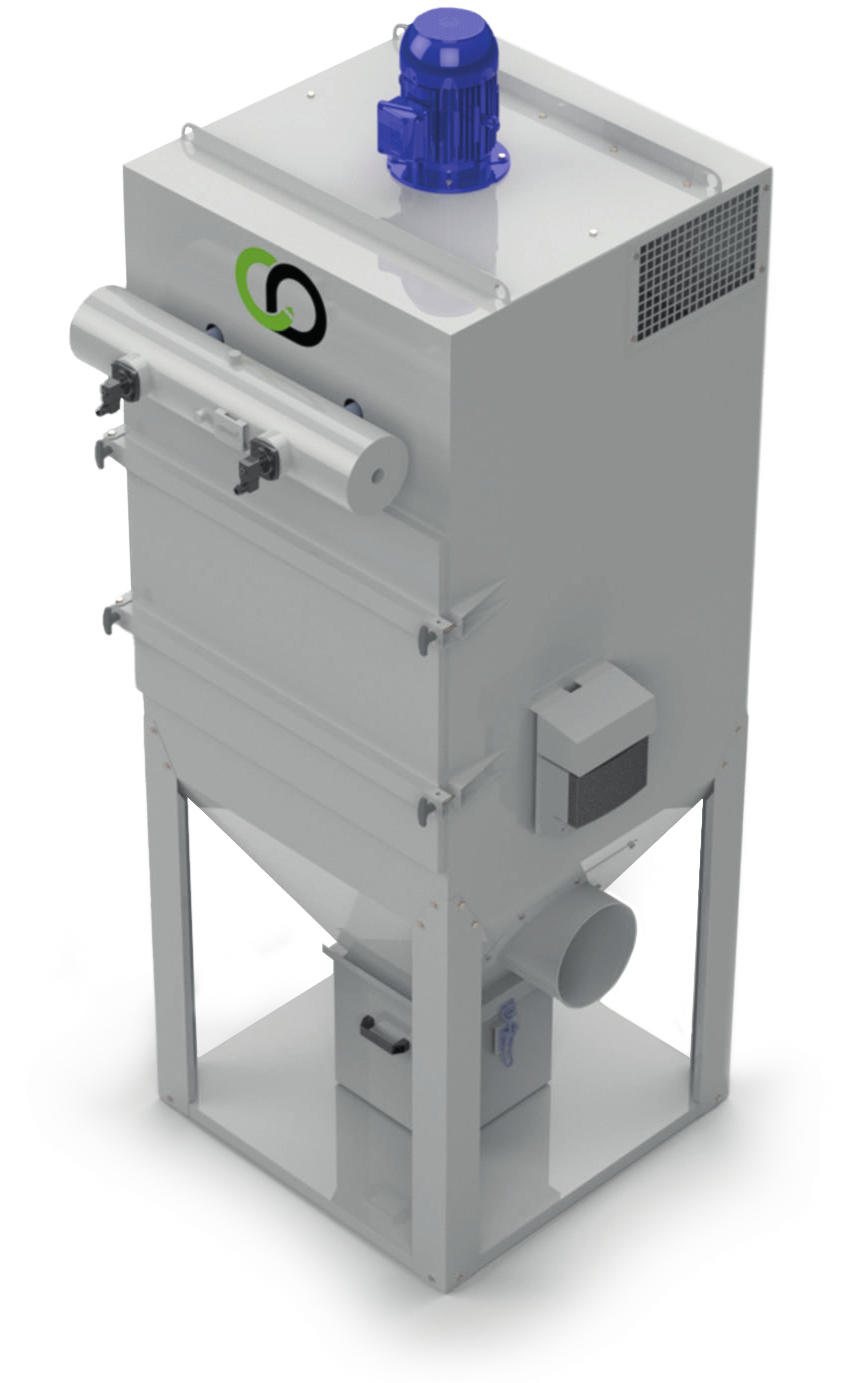
DAS CC
Continuous production 24/7
600 – 19 200 m³/h
Data sheet DAS CCFrench industrial expertise · Since 1994
H13 and H14 HEPA filters, also called absolute filters, for terminal filtration and final filtration after dust collection, all makes, to your dimensions.

01 / H13 and H14 HEPA filters
The EN 1822 standard classifies HEPA filters by their efficiency on the particles hardest to stop, about 0.1 to 0.3 micron. An H13 filter retains at least 99.95% of them, an H14 filter at least 99.995%.
The ISO 29463 standard uses another notation: ISO 35 H roughly corresponds to H13, ISO 45 H to H14. A HEPA filter is also called an “absolute filter”.
02 / H13 and H14 HEPA filters
As terminal filtration of supply air: cleanrooms, laboratories, pharmaceutical and food industries.
Downstream of a dust collector, an H13 stage filters the air before it is discharged or returned to the workshop, when the nature of the dust and the regulations allow it. Our DAS CC dust collectors can be fitted with an H13 filter housing.
03 / H13 and H14 HEPA filters
Under EN 1822, every H13 or H14 filter is tested individually by its manufacturer; the class and the result appear on the label or certificate.
A HEPA filter is protected by one or two pre-filtration stages, for example G4 then F7. Without a pre-filter, it clogs quickly and is expensive to replace.
04 / H13 and H14 HEPA filters
HEPA filters come with wooden, metal or plastic frames, in standard or compact depth, with a flat gasket, gel seal or knife edge depending on the housing.
The tightness of the fitting matters as much as the class: a leak at the seal lets unfiltered air through. For a replacement, note the dimensions (width × height × depth), the class and the type of seal.
Compare the equipment
These data sheets let you compare technologies and operating conditions. Compatibility with your process and the equipment configuration are confirmed before the final choice.
Continuous production 24/7
600 – 19 200 m³/h
Data sheet DAS CCUseful answers
The H13 retains at least 99.95% of the most penetrating particles, the H14 at least 99.995%. The H14 therefore lets ten times fewer particles through, usually with a higher pressure drop.
Another name for a HEPA filter, class H13 or H14 under EN 1822.
Yes. One or two pre-filtration stages retain coarse and medium particles and significantly extend the life of the HEPA filter.
It is possible for some dusts, after a study. Recirculation depends on the nature of the pollutant and the regulations; it is ruled out for certain hazardous substances.
Continue your selection
Your industrial project
Send us the dimensions, class and seal type of your HEPA filters, or a photo of the label: we reply with the reference and a quote.
Contact us
A technician from our engineering office studies your needs and proposes the right solution for your workshop: machine, capture, ductwork and filtration.
Reply within 48 working hours.
Your request, step by step
Pollutant, workstations, constraints: a few lines are enough. A photo of the installation helps us a lot.
Capture, airflow, ductwork and filtration are sized for your site, together with you if anything needs clarifying.
Machine, options and price, in detail: you decide with full knowledge of the facts.
Your cookie choices
With your consent, we use audience and advertising measurement cookies to understand how the site is used, improve it and see which ads bring us enquiries. You can accept, refuse or choose, and change your choice at any time. Learn more