
French industrial expertise · Since 1994
Industrial extraction hoods for furnaces, baths and presses
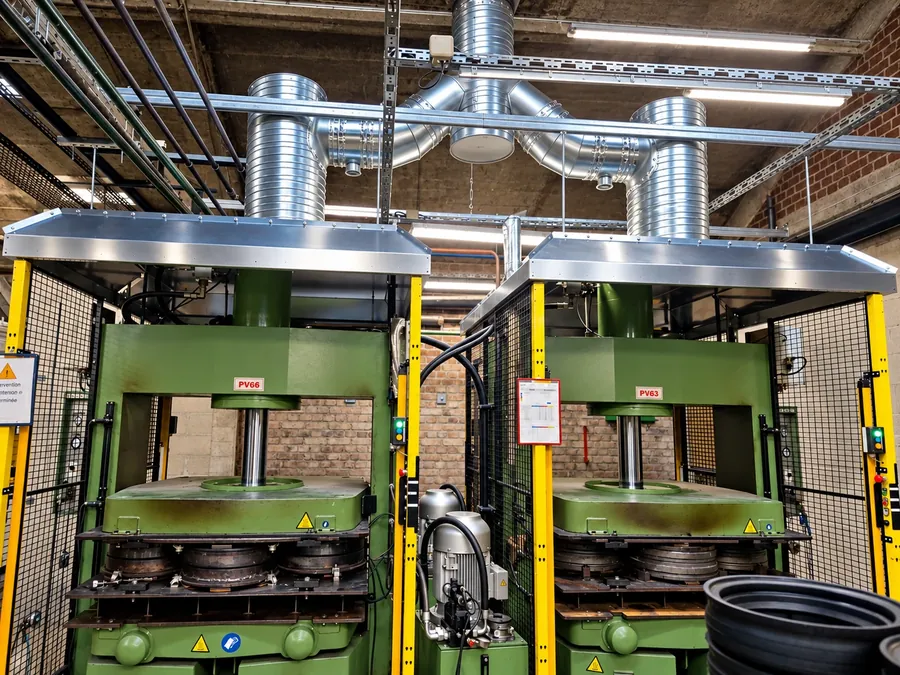
Canopy hoods above furnaces, baths, tanks and presses: for hot emissions that rise, sized from the perimeter and height of the hood.
01 / Industrial hoods
For hot emissions
A hood captures well what rises by itself: hot fumes and vapours above a furnace, a heated bath, a press or a heat-treatment machine. The plume carries the pollutant to the hood; the hood only has to receive it.
It is poorly suited to projected dust and to workstations where the operator leans over the emission: the hood then draws through the breathing zone. A guard, backdraft hood or arm is preferred in that case.
02 / Industrial hoods
The airflow of a hood
For a hood open on all four sides, the INRS gives Q = 1.4 × P × H × V, where P is the perimeter of the source, H the height between the source and the hood and V the target velocity. Closing two sides brings the airflow down to (b + L) × H × V (INRS ED 695).
Height weighs heavily: bringing the hood closer to the source, or closing its sides with skirts or curtains, directly reduces the airflow and the size of the fan.
03 / Industrial hoods
A worked example
A 1.2 × 0.8 m bath, hood 1 m above, target velocity 0.5 m/s in still air.
Hood open on all four sides: Q = 1.4 × 4 m × 1 m × 0.5 m/s = 2.8 m³/s, or 10,080 m³/h. Hood against the wall on two sides: Q = (1.2 + 0.8) × 1 × 0.5 = 1 m³/s, or 3,600 m³/h.
The same hood lowered to 0.6 m needs 40% less air: the fan, ducts and air treatment shrink accordingly.
04 / Industrial hoods
Dimensions and construction
The hood overhangs the source on each side to receive the plume, and its connection is placed directly above the main emission. It is made to measure, in galvanised steel or stainless steel for corrosive vapours.
For an open tank, a slot hood on the rim or a Pouyès ring often captures better than a hood, with less air.
05 / Industrial hoods
Materials and finishes
Painted steel, galvanised steel, 304 or 316L stainless steel, and polypropylene (PPH) for acid vapours from surface-treatment baths.
Depending on the workstation: condensate tray, skirts or strip curtains to close the sides, inspection hatches.
06 / Industrial hoods
What we need to quote
The dimensions of the source, the height available above it, the temperature and nature of the emissions, and a photo of the workstation.
Useful answers
Frequently asked questions
What airflow for an industrial hood?
For a hood open on four sides: 1.4 × perimeter of the source × height × velocity. Closing two sides reduces it significantly.
Hood or enclosure?
The hood for what rises by itself (vapours and hot fumes); the enclosure for what is projected (grinding, machining).
What capture velocity under a hood?
0.5 m/s at the source in still air, more if draughts cross the workstation (INRS ED 695).
Can a hood capture dust?
Only if it rises with a hot plume: melting, furnace or casting fumes. Cold or projected dust is captured by an enclosure or an opening as close as possible.
Hood or extraction ring for a tank?
For an open tank where the operator works, a ring or slot on the rim captures with less air and leaves access free.
Continue your selection
Related solutions and guides
Your industrial project
Tell us what you need.
Give us the dimensions of the source, the height available and the nature of the emissions: we design the hood and size the extraction.
Contact us
Let’s talk about your installation.
A technician from our engineering office studies your needs and proposes the right solution for your workshop: machine, capture, ductwork and filtration.
Reply within 48 working hours.
Your request, step by step
-
1
You describe your needs
Pollutant, workstations, constraints: a few lines are enough. A photo of the installation helps us a lot.
-
2
Our engineering office studies it
Capture, airflow, ductwork and filtration are sized for your site, together with you if anything needs clarifying.
-
3
You receive a written proposal
Machine, options and price, in detail: you decide with full knowledge of the facts.
- Since 1994in industrial air treatment
- In-house engineering officefrom design to supply
- All brandsfilters and spare parts
- French Fabnetwork member