
French industrial expertise · Since 1994
Roof extraction fans
BT roof extraction fans, from 1,300 to 15,000 m³/h and up to 1,050 Pa, to remove hot or stale air from workshops and premises.
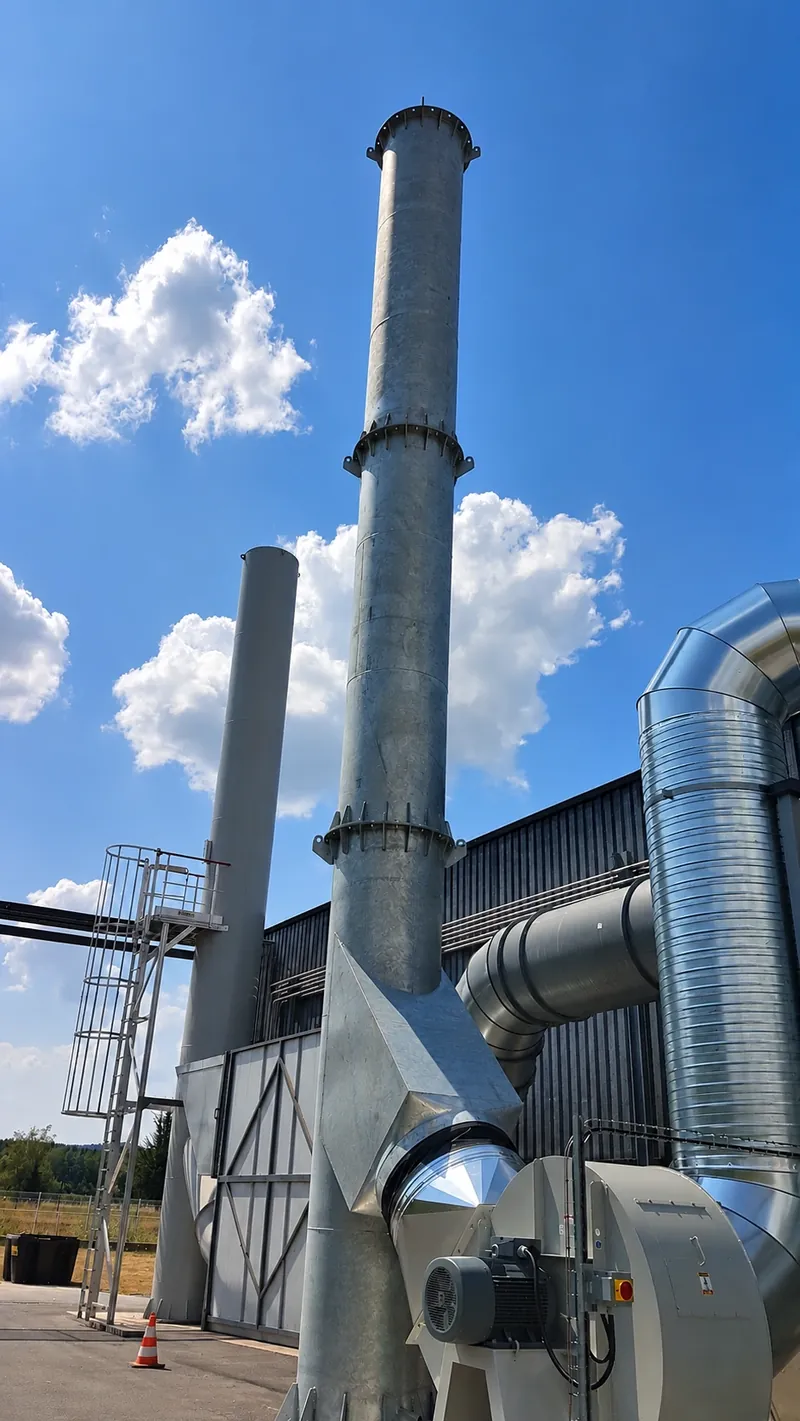
01 / Roof fans
What a roof fan does
Installed on the roof, the roof fan extracts stale or hot air from a room and discharges it directly outdoors. It frees floor space and keeps noise away from the workstations.
It provides general ventilation: heat, humidity, odours, diffuse pollutants. Pollutants emitted at a specific workstation are captured at source, by a hood connected to ductwork.
02 / Roof fans
Our BT range
Our BT roof fans cover 1,300 to 15,000 m³/h, at a pressure of 130 to 1,050 Pa. They extract air directly from the room or connect to ductwork.
03 / Roof fans
Planning the air inlet
Extracting air means letting the same amount in. Without a fresh-air inlet, the room goes into negative pressure: doors are hard to open, the extracted airflow falls and the hoods lose efficiency.
Provide air inlets or a supply-air unit of equivalent airflow.
04 / Roof fans
Sizing
The airflow is calculated from the volume of the room, the activity and the heat to remove.
In rooms without specific pollution, the French Labour Code sets a minimum of fresh air per occupant: 45 m³/h in a workshop with light physical work, 60 m³/h in other workshops.
05 / Roof fans
Calculating the airflow from the heat load
To remove a heat load P (in watts) with a temperature difference ΔT between extracted and fresh air: Q (m³/h) ≈ 3 × P / ΔT, for air at 1.2 kg/m³.
Example: machines giving off 30 kW and an accepted difference of 5 °C need 3 × 30,000 / 5 = 18,000 m³/h, i.e. two 9,000 m³/h BT roof fans placed above the hot zones. With a 3 °C difference, 30,000 m³/h are needed.
06 / Roof fans
Where to place the roof fans
Above the heat sources: hot air rises and the roof fan takes it where it accumulates.
Away from fresh-air intakes and roof openings, so that the discharged air is not drawn back in.
Connected to ductwork, the roof fan must overcome the pressure drop of the ducts: up to 1,050 Pa in the BT range. Beyond that, a centrifugal fan takes over.
Useful answers
Frequently asked questions
Roof fan or wall extractor?
The roof fan discharges at roof level, away from windows and air intakes, and takes up no wall space. A wall extractor suits rooms without roof access.
What airflow to ventilate a workshop?
It depends on the volume, the activity and the heat sources. For a workshop without specific pollution, the French Labour Code requires at least 45 or 60 m³/h of fresh air per occupant depending on the activity.
Is a roof fan enough for welding fumes?
No. Fumes are captured at the workstation, by an arm or a downdraft table. The roof fan complements the general ventilation of the room.
How many roof fans for a workshop?
The total airflow divided by the airflow of one roof fan, spread above the hot zones. Several medium-sized roof fans ventilate better than a single large one.
Can a roof fan be connected to a duct?
Yes, up to 1,050 Pa of pressure drop in the BT range. For more resistant ductwork, we move to a centrifugal fan.
Continue your selection
Related solutions and guides
Your industrial project
Tell us what you need.
Give us the dimensions of the room, the activity and the number of people, or the target airflow: we size the roof fans and send you a quote.
Contact us
Let’s talk about your installation.
A technician from our engineering office studies your needs and proposes the right solution for your workshop: machine, capture, ductwork and filtration.
Reply within 48 working hours.
Your request, step by step
-
1
You describe your needs
Pollutant, workstations, constraints: a few lines are enough. A photo of the installation helps us a lot.
-
2
Our engineering office studies it
Capture, airflow, ductwork and filtration are sized for your site, together with you if anything needs clarifying.
-
3
You receive a written proposal
Machine, options and price, in detail: you decide with full knowledge of the facts.
- Since 1994in industrial air treatment
- In-house engineering officefrom design to supply
- All brandsfilters and spare parts
- French Fabnetwork member