
French industrial expertise · Since 1994
Industrial centrifugal fans: ranges and selection
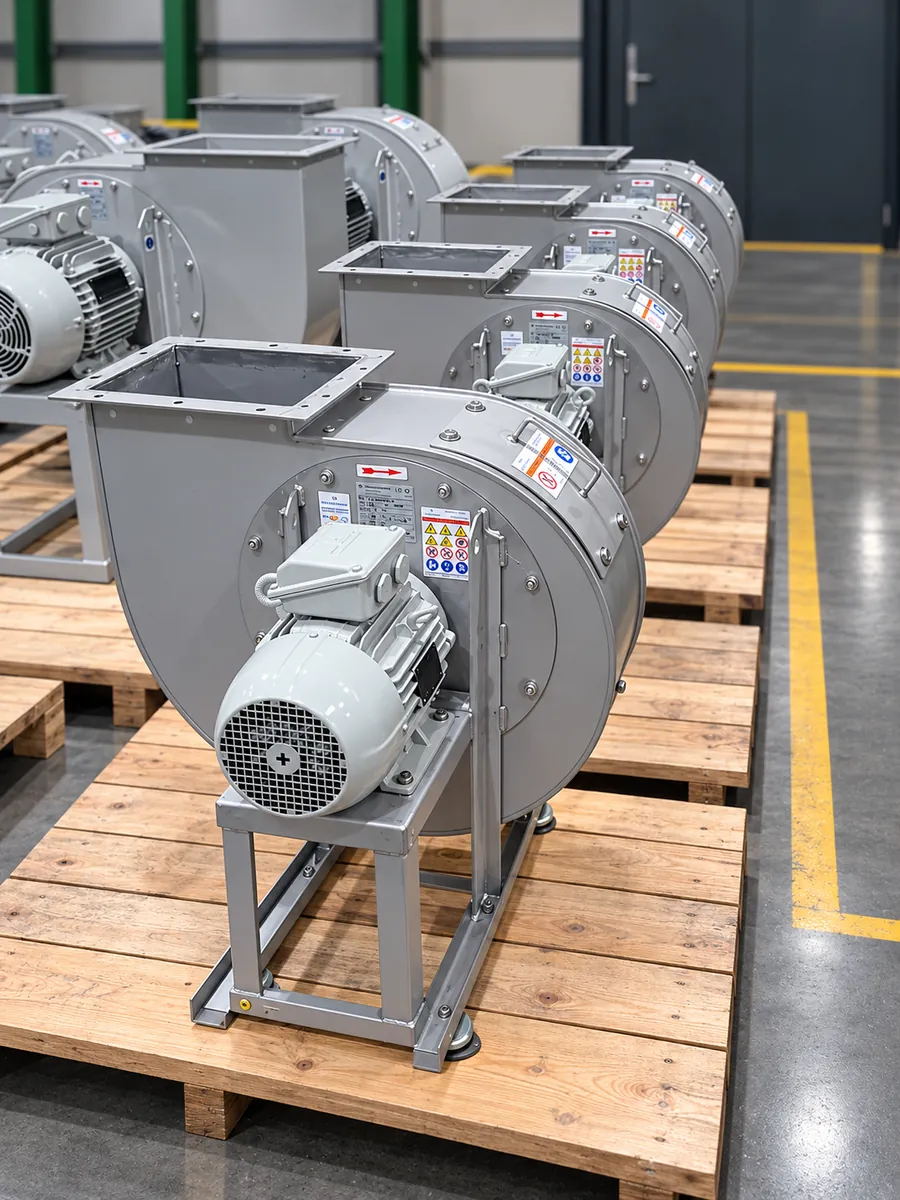
Low and medium-pressure industrial centrifugal fans, from 180 to 170,000 m³/h and up to 10,740 Pa: clean air, dust-laden air, high temperature, ATEX.
01 / Centrifugal fans
Start from the ductwork, not the motor
A fan is selected at its operating point: the airflow to move and the pressure needed to overcome the pressure drop of the ductwork, hoods and filter. The motor power does not say enough.
The BP and BPR low-pressure ranges go up to 3,820 Pa, for short duct runs and clean air. The EU, EUK, MPR and TR medium-pressure ranges go up to 10,740 Pa, for long duct runs, dust collectors and material conveying.
02 / Centrifugal fans
Clean air or dust-laden air
For clean or slightly dusty air, the backward-curved impeller of the BP and BPR ranges offers good efficiency and low noise: ventilation, drying, cooling, draught.
For air laden with metal chips or conveyed materials, the EU and TR ranges accept suspended particles. Stringy materials are excluded.
03 / Centrifugal fans
Construction and options
Standard steel, AISI 304 or 316 stainless steel, manganese steels for corrosive or abrasive fluids. Up to 80 °C as standard and 150 °C with a shaft cooling fan.
Direct drive or belt drive, outlet adjustable in 16 positions, ATEX execution for explosive atmospheres.
04 / Centrifugal fans
The data for a quote
The airflow (m³/h), the total pressure (Pa) or a description of the ductwork, the nature and temperature of the air, the presence of dust or flammable vapours, the space available and the power supply.
Without a ductwork calculation, our engineering office determines the operating point from your layout.
Useful answers
Frequently asked questions
What is the difference between a low and a medium-pressure fan?
The pressure it can deliver. A low-pressure fan suits short ductwork with little resistance; a medium-pressure fan overcomes the pressure drop of a dust collector or a long extraction system.
Can dust pass through the fan?
Yes, with an impeller designed for dust-laden air: the EU and TR ranges accept air laden with metal chips or conveyed materials. A backward-curved impeller is reserved for clean or slightly dusty air.
Does the fan go before or after the filter?
Usually after, on the clean-air side: it is then protected from abrasion and fouling. It goes before the filter when it has to convey the material.
Continue your selection
Related solutions and guides
Your industrial project
Tell us what you need.
Give us the airflow, the pressure or your ductwork layout, and the nature of the air conveyed: we select the fan and send you a quote.
Contact us
Let’s talk about your installation.
A technician from our engineering office studies your needs and proposes the right solution for your workshop: machine, capture, ductwork and filtration.
Reply within 48 working hours.
Your request, step by step
-
1
You describe your needs
Pollutant, workstations, constraints: a few lines are enough. A photo of the installation helps us a lot.
-
2
Our engineering office studies it
Capture, airflow, ductwork and filtration are sized for your site, together with you if anything needs clarifying.
-
3
You receive a written proposal
Machine, options and price, in detail: you decide with full knowledge of the facts.
- Since 1994in industrial air treatment
- In-house engineering officefrom design to supply
- All brandsfilters and spare parts
- French Fabnetwork member