
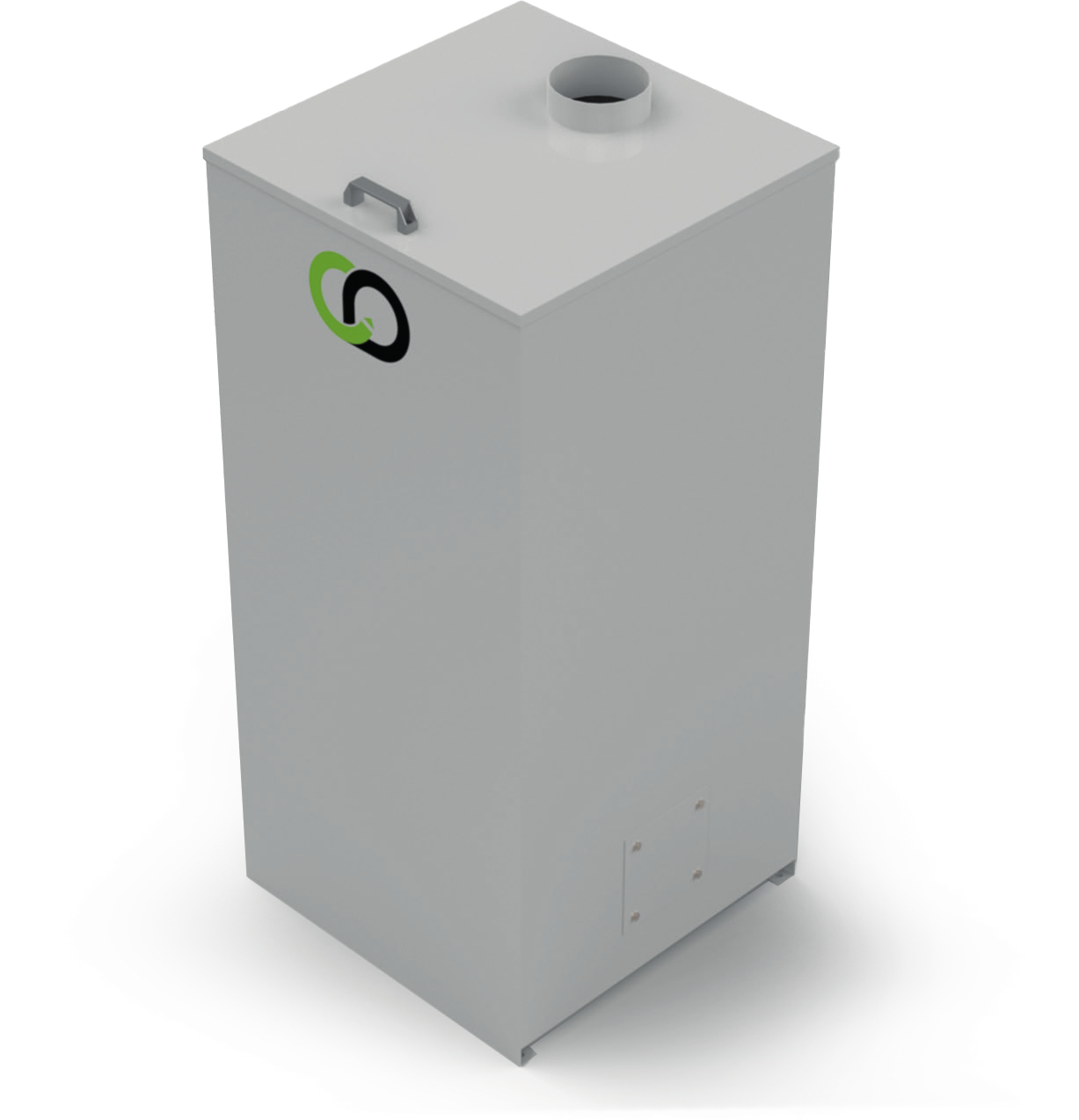
Bag-type DA
Low dust loads
250 – 2 000 m³/h
Data sheet Bag-type DAFrench industrial expertise · Since 1994
Airflow, dust, production rate and filter cleaning: the four criteria for choosing an industrial dust collector, in order.
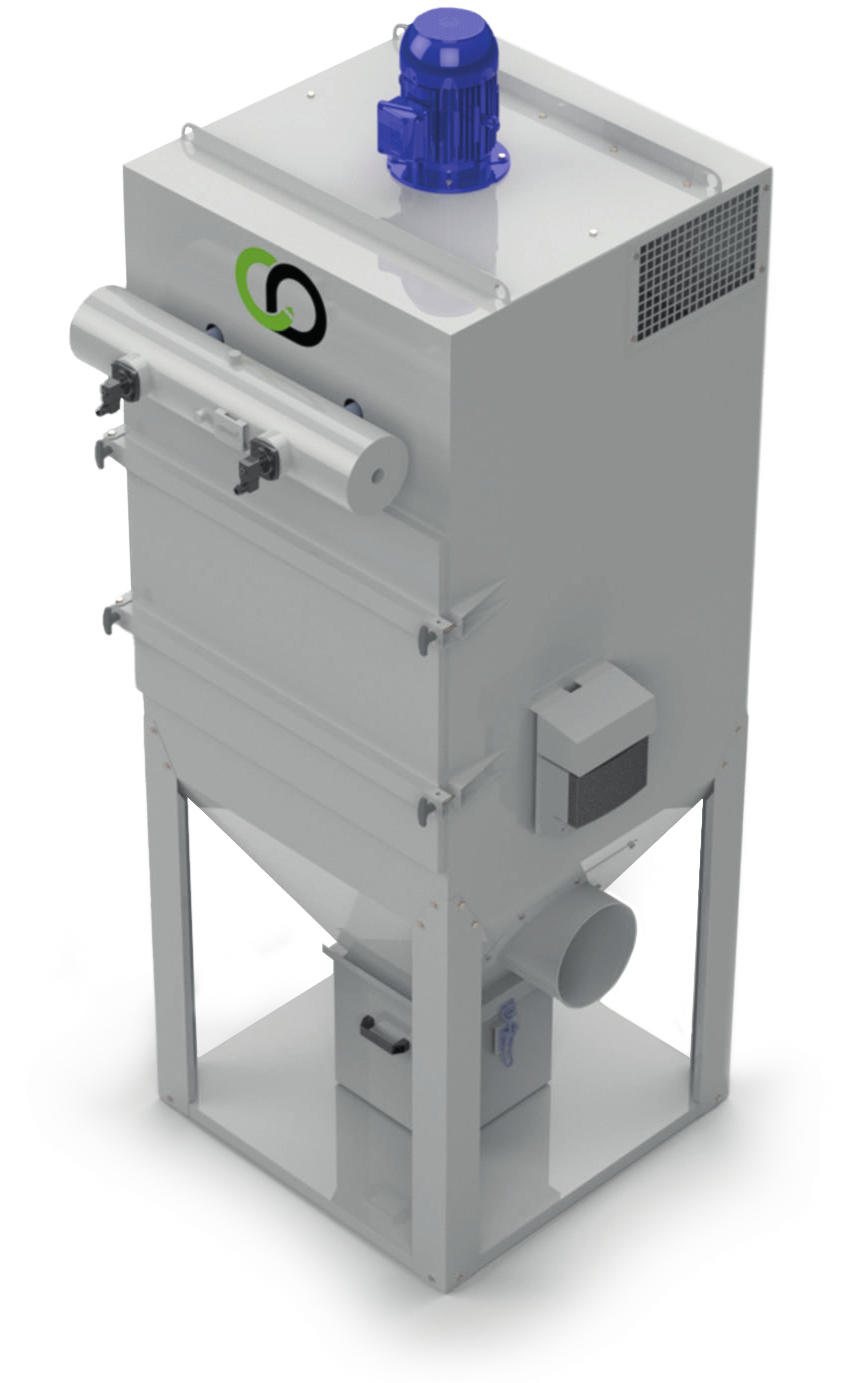
01 / Choosing a dust collector
The dust-laden air enters the housing; heavy particles drop straight into the hopper, fine ones are stopped on the surface of the filters (bags, sleeves or cartridges). The filtered air passes through the fan and leaves the unit.
The dust forms a cake on the medium: it improves filtration but increases the pressure drop. Filter cleaning, by shaking, motor or compressed-air pulses, drops it into the bin or drum.
02 / Choosing a dust collector
The airflow is the sum of the needs of the hoods used at the same time. It follows from the design of the hoods: the closer and more enclosing they are, the lower it is. Every unnecessary m³/h enlarges the filter area, the housing and the fan.
The dust collector is then selected at the operating point: this airflow, at the pressure needed to overcome hoods, ducts and filter.
03 / Choosing a dust collector
Dry and non-sticky: dry filtration on bag, sleeve or cartridge. Greasy or fibrous (polishing compounds): more area and a PTFE medium. Combustible (aluminium, magnesium, wood): wet process or ATEX execution. Very fine: an H13 stage before discharge.
04 / Choosing a dust collector
The medium is chosen according to the dust: polyester for dry dust, antistatic polyester for conductive or combustible dust, PTFE treatment or membrane for fine, greasy or sticky dust.
The filter area is sized to the airflow: too small, the filter clogs quickly and the airflow drops; this is why the same airflow needs more area for fine dust.
Wet process (HYDRO, 600 to 5,000 m³/h): the dust is knocked down by water, with no dry filter. It is the solution for some combustible dusts, such as aluminium or magnesium.
05 / Choosing a dust collector
Occasional use: DA with bag (250 to 2,000 m³/h) or DA (400 to 5,000 m³/h), cleaned when stopped. Repeated cycles during the day: DAS, motorised cleaning at the end of the cycle. Continuous production: DAS CC (600 to 19,200 m³/h), cleaned during operation by compressed-air pulses.
06 / Choosing a dust collector
Indoors or outdoors, floor space, access to the filters, dust discharge (bin, drum, bagging), availability of compressed air for pneumatic cleaning. A pressure-drop indicator shows when to clean or change the filters.
Compare the equipment
These data sheets let you compare technologies and operating conditions. Compatibility with your process and the equipment configuration are confirmed before the final choice.
Low dust loads
250 – 2 000 m³/h
Data sheet Bag-type DA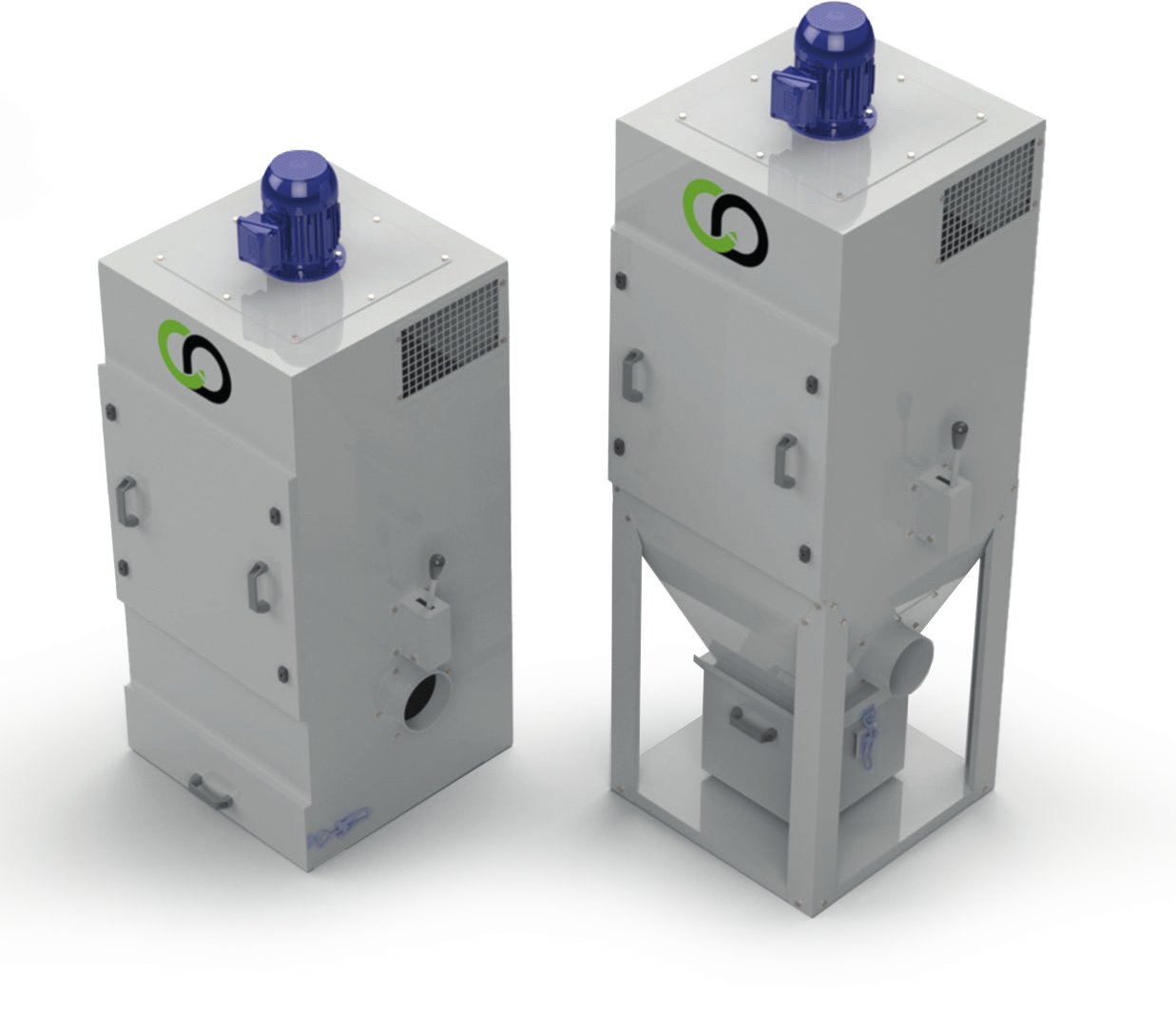
Occasional use
400 – 5 000 m³/h
Data sheet DA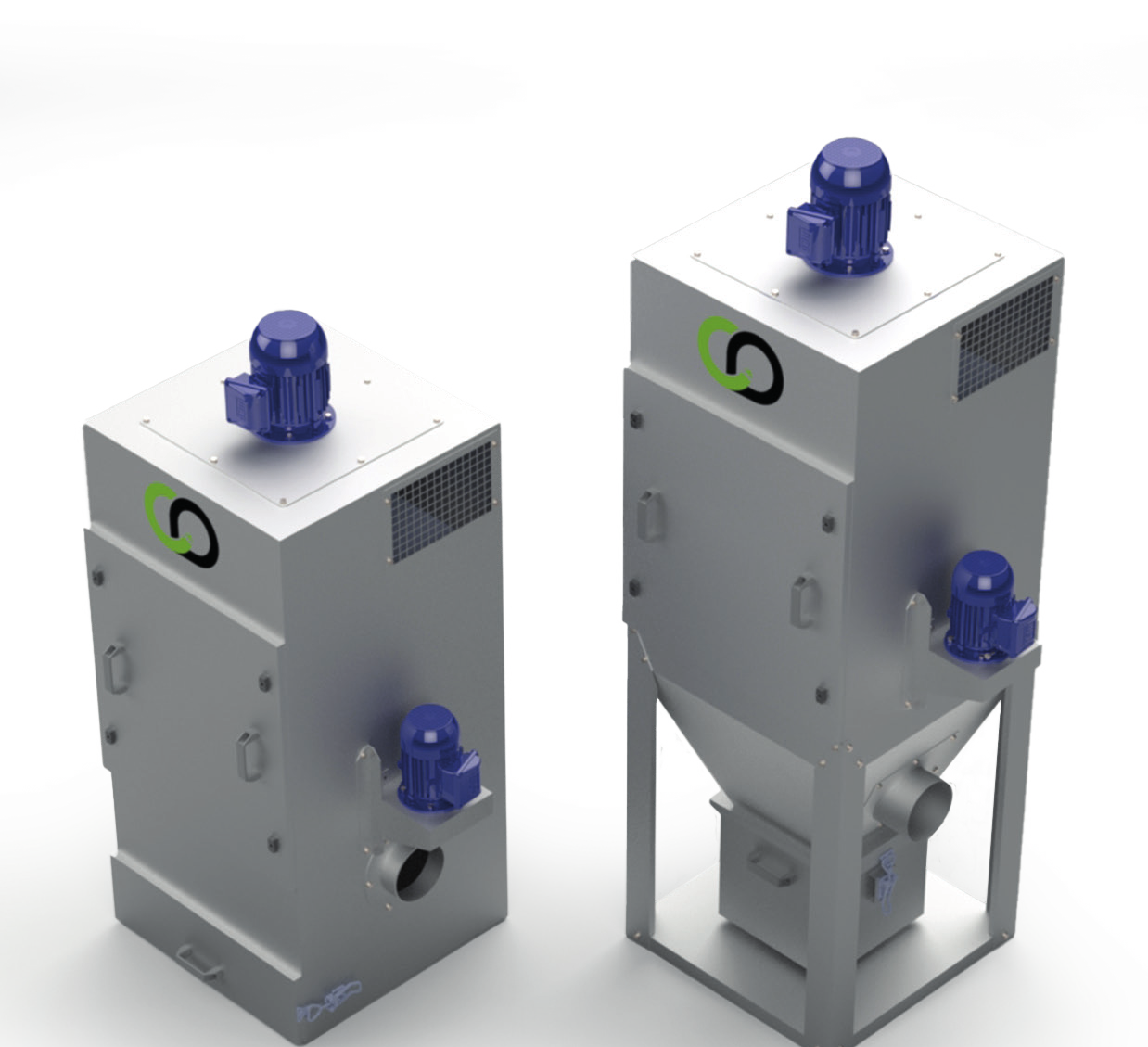
Daily intermittent use
400 – 5 000 m³/h
Data sheet DASContinuous production 24/7
600 – 19 200 m³/h
Data sheet DAS CC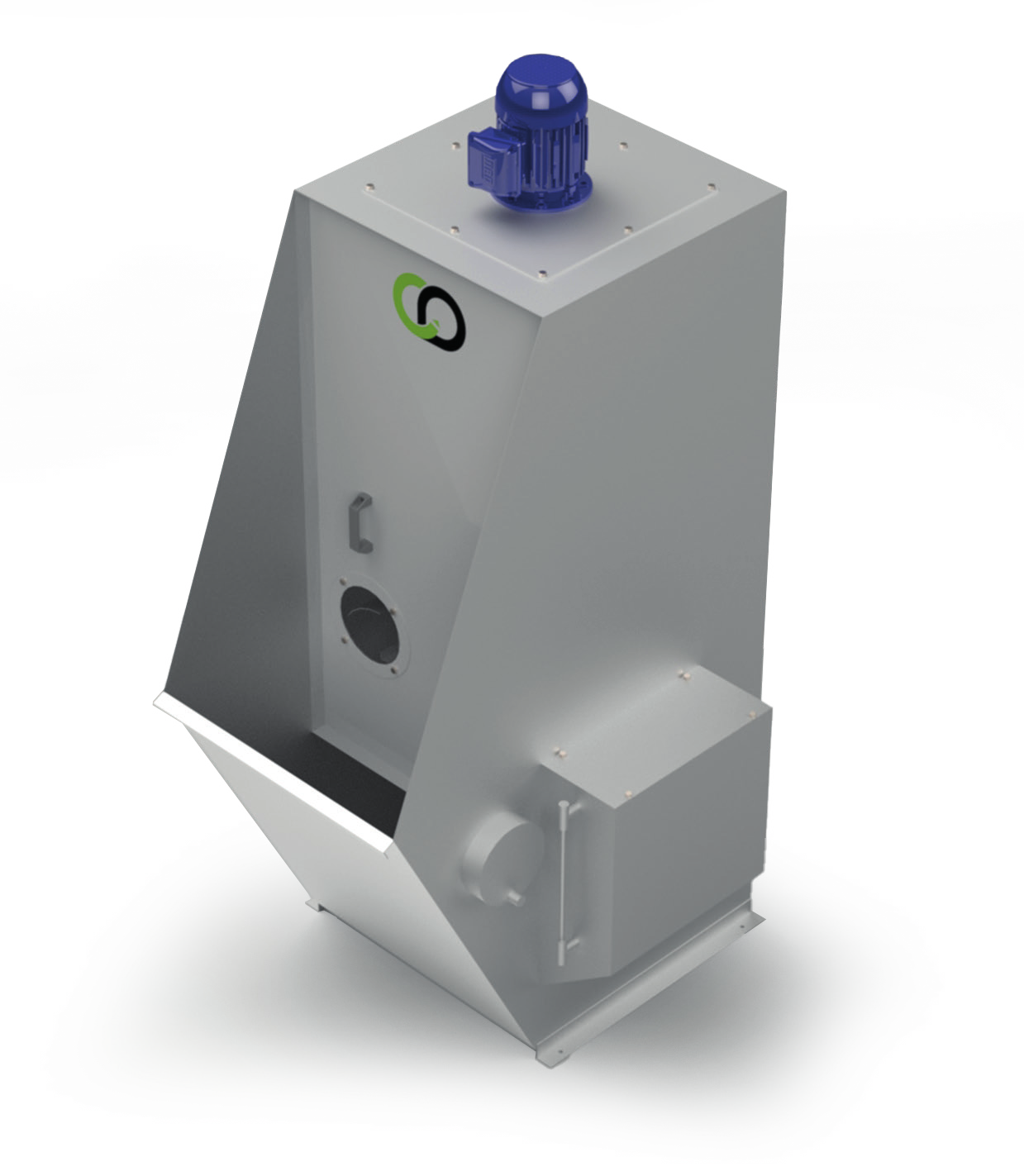
Wet dust collection
600 – 5 000 m³/h
Data sheet HYDROUseful answers
No. A cartridge offers a lot of area in little space, but a bag is enough for a light load and a wet process is required for some combustible dusts.
No: by the airflow and pressure available. Two motors of the same power can give very different airflows depending on the fan and the ductwork.
By adding up the airflows of the hoods used at the same time, each calculated from the capture velocity (for an opening: Q = V × (10 X² + A), INRS ED 695). See our sizing guide.
Sleeves (DA, DAS) are cleaned when stopped and suit occasional or daily use. Cartridges (DAS CC) offer more area in less space and are cleaned on-line, for continuous production.
Continue your selection
Your industrial project
Send us photos of the workstations, the materials worked, which workstations run at the same time and your working hours: we size the capture and filtration and send you a costed quote.
Contact us
A technician from our engineering office studies your needs and proposes the right solution for your workshop: machine, capture, ductwork and filtration.
Reply within 48 working hours.
Your request, step by step
Pollutant, workstations, constraints: a few lines are enough. A photo of the installation helps us a lot.
Capture, airflow, ductwork and filtration are sized for your site, together with you if anything needs clarifying.
Machine, options and price, in detail: you decide with full knowledge of the facts.
Your cookie choices
With your consent, we use audience and advertising measurement cookies to understand how the site is used, improve it and see which ads bring us enquiries. You can accept, refuse or choose, and change your choice at any time. Learn more